Jet Lag Doesn't Stand a Chance: How Hot Stone Therapy Is Replacing Every Sleep Hack in the American Traveler's Toolkit
Photo: Muybridge, Eadweard, 1830-1904, Public domain, via Wikimedia Commons
You've done everything right. You downloaded the sleep-tracking app. You took the melatonin at exactly the recommended time. You wore the blue-light-blocking glasses on the plane like a person who has absolutely given up caring what strangers think. And yet, at 3:47 a.m. Tokyo time, you are wide awake, staring at the ceiling of your hotel room, doing mental arithmetic about how many hours of daylight you're going to waste feeling like a zombie.
American travelers know this story intimately. The flight from Los Angeles to Tokyo is roughly 11 to 13 hours. From New York, add a couple more. The time difference hovers between 13 and 16 hours depending on the season, which means your body isn't just confused — it's operating in a completely parallel reality. And the standard pharmaceutical toolkit? Most frequent Japan travelers will tell you, with some frustration, that it helps at the margins.
What a growing number of those same travelers are now swearing by instead is ganbanyoku — Japan's traditional heated stone bath practice — and the results they're describing are striking enough to make you reconsider your entire pre-trip packing list.
What's Actually Happening to Your Body at 30,000 Feet
Before getting into the hot rocks, it helps to understand what jet lag is actually doing to your physiology. Your circadian rhythm — the internal clock that governs sleep, hormone release, digestion, and about a dozen other systems — is regulated primarily by light exposure and, crucially, by core body temperature fluctuations.
Under normal conditions, your body temperature drops slightly in the evening, signaling to your brain that sleep is approaching. It rises again in the early morning hours, helping you wake up. Cross 13 time zones in a pressurized aluminum tube and that entire thermal signaling system gets thrown into chaos. Your body thinks it's 10 a.m. when it's actually midnight. The melatonin your brain produces gets released at the wrong times. You feel exhausted during daylight and wired at 2 a.m.
This is where ganbanyoku enters the conversation in a genuinely interesting way.
The Thermal Reset You Didn't Know You Needed
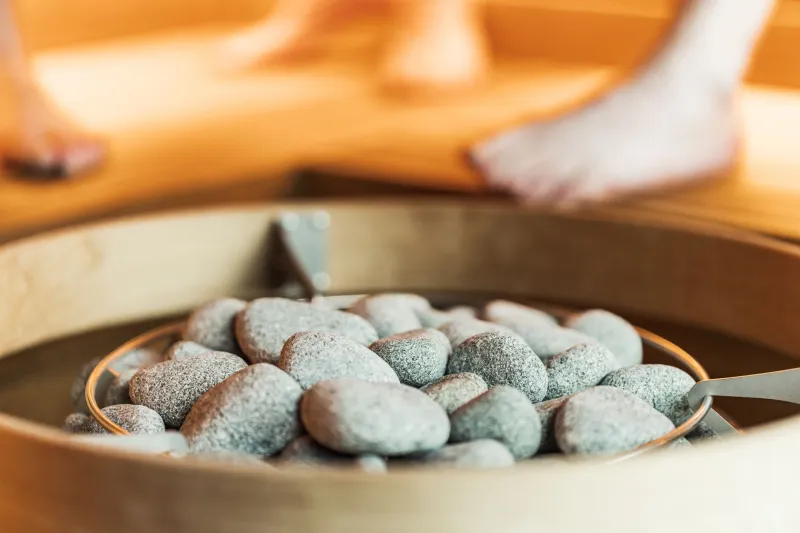
Ganbanyoku involves lying on flat stone surfaces — typically black silica, tourmaline, or far-infrared-emitting volcanic rock — heated to temperatures between roughly 40°C and 45°C (104°F to 113°F). Unlike a traditional sauna, which heats the air around you, ganbanyoku heats your body from the outside in, using radiant far-infrared energy that penetrates several centimeters beneath the skin.
Here's what that does to your sleep architecture: the sustained, gentle elevation of core body temperature followed by the natural cooling that happens when you leave the stone room mimics, in an accelerated and amplified form, the exact thermal drop your body uses as a sleep onset signal. You're essentially hacking your own circadian trigger.
Research on heat therapy and sleep quality has consistently shown that raising core body temperature before bed — through hot baths, saunas, or similar modalities — can significantly shorten sleep onset time and increase slow-wave (deep) sleep duration. A widely cited study in the journal Sleep Medicine Reviews found that passive body heating improved both subjective and objective sleep quality markers. Ganbanyoku, with its longer duration and more uniform heat distribution compared to a quick shower, may amplify these effects.
Dr. Keiko Yamamoto, a wellness researcher based in Kyoto who has consulted with several traditional onsen facilities, describes it this way: "The body's thermoregulatory response to ganbanyoku is more gradual and sustained than a bath or sauna. That extended thermal curve, followed by the cooling period, appears to create a stronger circadian signal. For someone whose clock is already disrupted, it can act like a reset button."
What Travelers Are Actually Experiencing
The anecdotal evidence is piling up in ways that are hard to ignore.
Marissa, a 34-year-old marketing director from Chicago, has made four trips to Japan over the past six years. On her first trip, she struggled badly with jet lag for nearly four days. On her second, a colleague suggested she find a ganbanyoku facility near her hotel in Osaka and go on the evening she arrived.
"I was skeptical," she admits. "I'd tried everything — the melatonin timing trick, the fasting-on-the-plane thing, all of it. But I went, did about 45 minutes on the stones, drank a lot of water, and went back to the hotel. I was asleep by 10 p.m. local time and slept until 6:30 in the morning. First night. I could not believe it."
That experience is not unusual among travelers who've deliberately used ganbanyoku as a jet lag intervention. Kevin, a 41-year-old software engineer from Seattle who travels to Japan twice a year for work, now schedules his first-evening ganbanyoku session the way other travelers schedule airport transfers — it's just part of the arrival routine.
"The combination of the heat, the forced stillness, and honestly just the sensory unfamiliarity of the whole experience seems to exhaust my nervous system in a good way," he says. "Like, my brain stops trying to figure out what time it is and just... surrenders. I sleep better that first night in Japan than I do most nights at home."
Strategic Timing: First Night vs. Last Night
There's an emerging split among experienced ganbanyoku travelers about when to deploy the rock bath strategically.
The first-night camp argues that an evening session immediately upon arrival — ideally between 7 p.m. and 9 p.m. local Japan time — gives the body its best shot at syncing to the new time zone before sleep debt accumulates and bad patterns set in. The heat-induced sedation effect is strongest when you're already physically exhausted from travel, and the combination can produce unusually deep first-night sleep.
The last-night camp makes a different case: a ganbanyoku session the evening before your return flight, they argue, helps pre-load your body with deep sleep before the disruption of a westbound transoceanic flight. Some travelers report that the post-ganbanyoku sleep quality is good enough to carry them through the flight itself, arriving back in the US less depleted than usual.
The honest answer is probably both, if your itinerary allows it. Several travelers interviewed for this piece now book facilities near their arrival and departure cities specifically for this reason — a ganbanyoku spot near Shinjuku for the Tokyo arrival, one near Namba for the Osaka departure, and so on.
A Few Practical Notes Before You Go
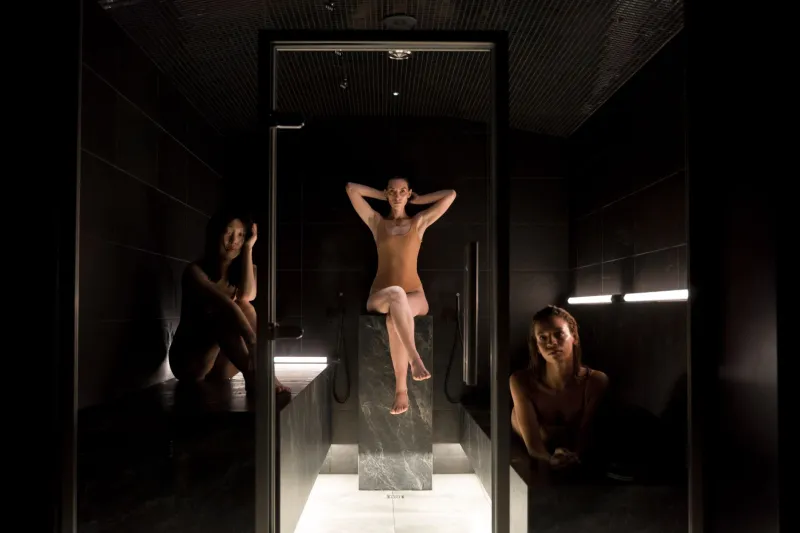
Ganbanyoku is generally considered safe for healthy adults, but there are a few things worth knowing if you're using it as a jet lag tool specifically. Hydration is more important than usual when you're already dehydrated from a long flight — drink water before, during, and after. Most facilities provide a towel to lie on and ask guests to wear lightweight clothing (often provided), which is different from traditional onsen bathing, so the barrier to entry is lower than nervous first-timers might expect.
Session lengths typically run in 15-to-20-minute intervals with rest periods in between. For jet lag purposes, most travelers report that one to two full intervals — 30 to 45 minutes total on the stone — is sufficient to produce the sleep-onset effect without tipping into overstimulation.
And if you've been burned by every sleep hack you've ever tried on a Japan trip? This one might actually be different. The stones have been warm for centuries. Your circadian rhythm doesn't stand a chance.