Your Senses Are About to Get Very Weird: The Science Behind Ganbanyoku's Near-Hallucinogenic Calm

No one warns you about this part.
You've read about the sweating, the mineral content, the far-infrared heat. You know to bring a towel, to hydrate, to keep your sessions under an hour. What nobody quite prepares you for is walking out of the ganbanyoku room and feeling like someone quietly turned up the resolution on the world.
The vending machine in the hallway looks more vivid than it should. The sound of slippers on tile feels oddly satisfying, like it's landing somewhere inside your chest. Your own heartbeat seems louder, slower, and somehow more interesting than it's ever been before.
You're not hallucinating. But you're not quite experiencing the world the way you were forty-five minutes ago either.
Welcome to what researchers who study sensory processing and thermal therapy are starting to call one of the more underexplored effects of deep, sustained heat exposure — a temporary but measurable recalibration of how your nervous system interprets the world around it.
What's Actually Happening Inside the Room
To understand the perceptual shift, it helps to understand what ganbanyoku is doing to your body at a systems level.
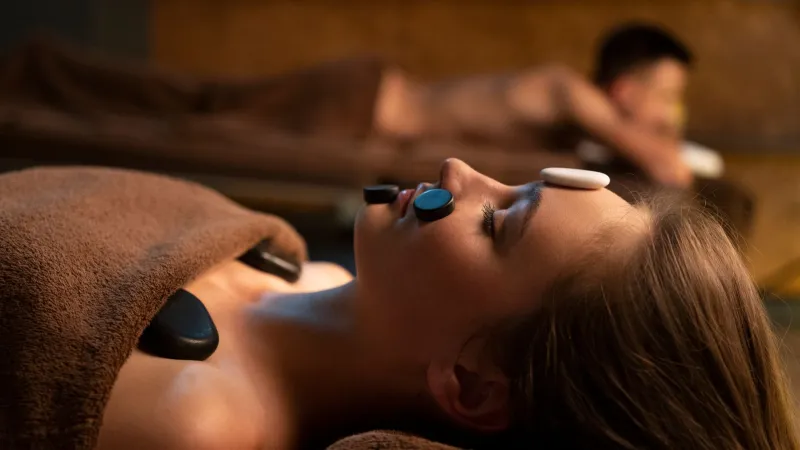
The heated stone beds — typically made from materials like black silica, tourmaline, or bian stone — emit far-infrared radiation in a wavelength range that human tissue absorbs particularly efficiently. Unlike the convective heat of a sauna, which warms the air around you, far-infrared heat works from the inside out, elevating core body temperature gradually and penetrating several centimeters below the skin's surface.
This thermal load triggers a cascade of physiological responses. Blood vessels dilate significantly, increasing peripheral circulation. The parasympathetic nervous system — your rest-and-digest mode — takes over from the sympathetic fight-or-flight state most Americans spend their days locked in. Core temperature rises enough to induce a mild hyperthermia response, similar in some ways to what happens during a fever, but controlled and without the immune-system activation.
And then there's the sensory environment of the room itself: dim lighting, near-silence, horizontal stillness, the subtle mineral scent of heated stone. Strip away enough external stimulation and something interesting happens to the brain's sensory processing systems.
They start listening harder.
The Float Tank Comparison — And Where It Breaks Down
If you've ever tried a sensory deprivation float tank, some of this will sound familiar. Float tanks work by removing almost all external sensory input — no light, no sound, no gravity-driven pressure on the body — and the resulting perceptual experiences are well-documented. Heightened body awareness. Time distortion. Occasional visual phenomena as the brain, starved of input, begins generating its own.
Ganbanyoku isn't sensory deprivation. It's something more nuanced: sensory simplification.
The room doesn't eliminate input — it curates it. The warmth is constant and enveloping. The darkness is soft rather than absolute. The silence is ambient rather than total. What this does, according to researchers who study interoception (the brain's ability to sense internal body states), is shift the ratio of external to internal sensory signal processing.
When your environment stops demanding your attention, your brain redirects that processing bandwidth inward. Heartbeat. Breath. The sensation of blood moving through capillaries. The way heat feels different on your forearms than on your shoulders. Interoceptive awareness, which most Americans have essentially muted under layers of chronic overstimulation, comes back online.
The result isn't hallucination. It's something closer to the opposite — an unusually clear perception of what your body is actually doing, moment to moment, without the usual noise.
The Mineral Variable
Here's where ganbanyoku gets genuinely interesting from a sensory science perspective, and where it diverges from both float tanks and conventional saunas in ways that researchers are only beginning to examine.
Different stone types used in ganbanyoku rooms emit slightly different far-infrared wavelength profiles and, in some cases, trace amounts of naturally occurring minerals that are absorbed transdermally or inhaled in micro-quantities from heated stone surfaces. Bian stone, for example, has been the subject of Chinese and Japanese research examining its effects on microcirculation and autonomic nervous system tone.
The specific mineral composition of the stones you're lying on may be influencing your neurological state in ways that go beyond simple thermal effects. This is an area where the science is still developing — and where the anecdotal reports from visitors are running well ahead of the clinical literature.
What visitors consistently describe — the synesthetic crossover between senses, the feeling that sound has texture, that color has weight — maps onto what neuroscientists know about heightened thalamic sensitivity under conditions of deep parasympathetic activation. The thalamus, which acts as the brain's sensory relay station, processes incoming signals differently when the nervous system is in a profound rest state. Signals that normally get filtered or suppressed make it through.
You're not experiencing more. You're filtering less.
How This Compares to Sound Baths and Other Sensory Therapies
Sound baths — the practice of lying still while crystal bowls or gongs produce sustained tonal vibrations — have gained significant traction in American wellness circles over the past decade, and the experiential overlap with ganbanyoku is worth noting.
Both practices use horizontal stillness as a foundation. Both involve removing visual stimulation. Both produce reports of heightened body awareness and time distortion. The key difference is the entry mechanism: sound baths work through the auditory system and vibrational resonance; ganbanyoku works primarily through thermal and interoceptive channels.
What's interesting is that visitors who've experienced both often describe ganbanyoku as producing a deeper, more physically grounded version of the altered awareness — less dreamy, more embodied. Where a sound bath can feel transcendent, ganbanyoku tends to feel animal. You become aware of your body as a physical, living system in a way that is less mystical and more visceral.
For Americans who've tried every meditation app and sound healing workshop and still feel disconnected from their own physical experience, that distinction matters.
What to Do With This Information
The practical takeaway isn't to go chasing a psychedelic experience on a heated stone floor. The perceptual shifts that ganbanyoku produces are gentle, temporary, and entirely dependent on surrendering to the environment rather than trying to engineer a specific outcome.
But knowing the mechanism helps. When you walk out of your first session and the hallway feels strangely vivid, you'll know that's not jet lag or low blood sugar. That's your sensory system recalibrating after a period of unusual quiet — briefly perceiving the world with the filters partially lowered.
It's not magic. It's physiology.
And somehow, knowing that makes it even more remarkable.