Sacred Sweat: Why Americans Are Trading Religious Retreats for Japanese Rock Bath Pilgrimages
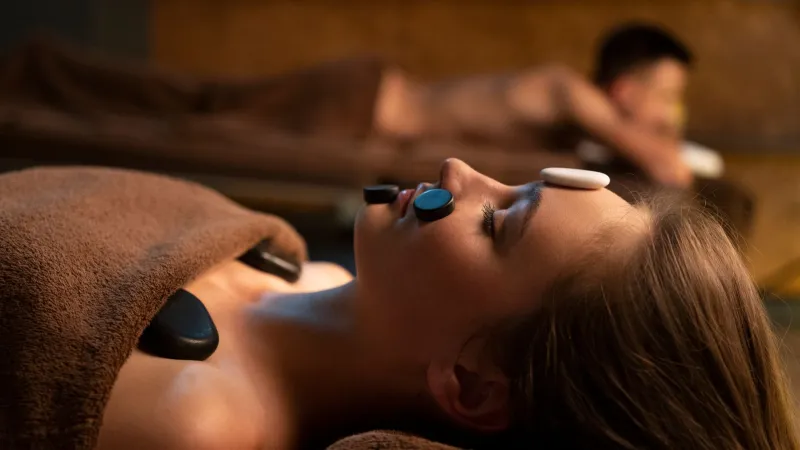
There's a moment that happens to a lot of first-time ganbanyoku visitors — usually somewhere around the twenty-minute mark, when the heat from the mineral stones has soaked through every layer of tension you didn't even know you were carrying. Your mind goes quiet. Not the forced quiet of a guided meditation, not the performative stillness of a yoga retreat. Just... quiet. For many Americans who've made the trip to Japan specifically for this experience, that moment feels less like a spa service and more like something they'd call, with a little hesitation, spiritual.
"I stopped going to church about ten years ago," says Marcus, a 38-year-old teacher from Portland, Oregon, who spent three weeks traveling between ganbanyoku facilities in Kyushu last spring. "I've tried everything — silent meditation retreats, sound baths, even a week at an ashram in upstate New York. Nothing stuck. But lying on those stones in a quiet room in Beppu, I felt something I hadn't felt since I was a kid sitting in a pew. Like I was part of something bigger than myself."
Marcus isn't alone in reaching for spiritual language to describe what is, technically, a form of thermal therapy. Across online travel forums, wellness blogs, and social media, Americans are increasingly framing their ganbanyoku journeys not as vacations or even wellness trips, but as pilgrimages.
The Ritual That Makes It Feel Sacred
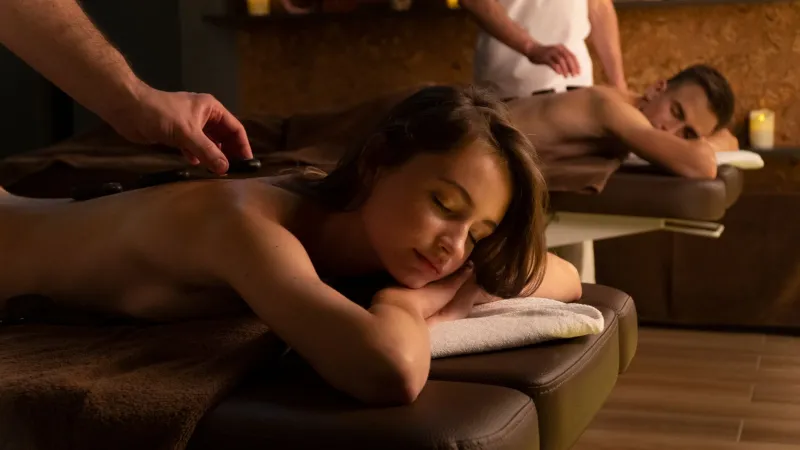
Part of what elevates ganbanyoku beyond a standard spa day is the structure surrounding it. Before you even lower yourself onto the heated stone floor, there's a sequence: the yukata you change into, the towel you spread beneath you, the water you're instructed to drink, the silence expected of everyone in the room. These aren't arbitrary rules — they're a kind of liturgy, a set of gestures that signal to your nervous system that something different is about to happen.
Japanese culture has long understood the relationship between ritual and transformation. The country's onsen tradition stretches back centuries, and ganbanyoku — where bathers recline on naturally heated mineral stones rather than submerging in water — carries its own distinct lineage. The stones themselves, often far-infrared-emitting varieties like tourmaline, bian stone, or black silica, are selected not just for their thermal properties but for their mineral composition, which is believed to interact beneficially with the body's energy.
For Americans raised in traditions where sacred space is defined by architecture — churches, synagogues, temples — the low-lit, minimalist stone room can feel unexpectedly holy. "There's no altar," says Priya, a 44-year-old therapist from Chicago who visited facilities in Hakone and Kusatsu. "But the room has this quality of intentionality. Everything is stripped down. You're just a person on a warm rock, sweating. And somehow that's enough."
Why Western Wellness Isn't Cutting It Anymore
To understand why ganbanyoku is resonating so deeply with spiritually curious Americans, it helps to understand what they're turning away from. The American wellness industry — worth well over a trillion dollars globally — has become, for many, indistinguishable from consumerism. Boutique meditation studios charge premium prices for experiences that feel curated rather than genuine. Retreat centers market "transformation" the way car dealerships market reliability. The result is a generation of wellness consumers who are exhausted by the very things designed to restore them.
Ganbanyoku sidesteps all of that, partly because it exists within a cultural context that was never trying to sell Americans anything. Japan's rock bath culture developed organically over generations, rooted in beliefs about the body's relationship with the earth's natural heat. When you visit a traditional ganbanyoku facility — particularly one attached to a regional onsen town rather than a city hotel — you're stepping into something that predates the wellness industrial complex entirely.
"I think people are hungry for practices that aren't about self-optimization," says Priya. "Ganbanyoku doesn't promise to make you more productive or give you better abs. It just asks you to lie still and let the heat do what it does. That's countercultural right now, and it feels honest."
Planning Your Own Rock Bath Pilgrimage
For Americans drawn to the idea of a ganbanyoku journey with genuine spiritual intention, a little planning goes a long way. The country's regional diversity means that different areas offer distinctly different energies — and yes, the word "energy" is being used deliberately here.
Beppu, Oita Prefecture is arguably the spiritual heartland of Japanese rock bath culture. The city sits atop one of the most geothermally active zones in the world, and its ganbanyoku facilities range from historic sand baths on the beach to purpose-built stone rooms in traditional ryokan. If you want the experience to feel ancient, start here.
Hakone, Kanagawa Prefecture offers a more contemplative setting, with facilities often positioned against backdrops of forest and mountain. The proximity to Mt. Fuji adds a layer of symbolic weight that even secular visitors tend to feel.
Noboribetsu, Hokkaido brings a rawer, more elemental quality — the landscape itself looks primordial, which tends to amplify whatever introspective mood you're already in.
For pilgrimage-minded travelers, moving between two or three regions over the course of a week or ten days creates a rhythm that mirrors traditional pilgrimage routes. You're not rushing. You're not ticking boxes. You're letting each location metabolize before moving on.
What Happens in the Silence
Back to that twenty-minute mark. What's actually happening when the quiet descends?
From a physiological standpoint, the far-infrared heat penetrating your body is triggering a cascade of responses — improved circulation, muscle relaxation, elevated core temperature — that collectively pull your nervous system toward a parasympathetic state. In plain language: your body stops bracing for impact. The fight-or-flight machinery that most Americans run on 24/7 goes temporarily offline.
In that gap, something tends to surface. For some visitors it's emotion — unexpected tears, a sudden sense of grief or gratitude. For others it's clarity, the kind that's been buried under to-do lists for months. For a few, it's genuinely difficult to describe in secular terms at all.
"I'm not a religious person," Marcus says carefully. "But I came out of that room in Beppu feeling like I'd been somewhere. Like I'd crossed a threshold. I don't know what to call that except sacred."
Maybe that's enough. Maybe the point of a pilgrimage — religious or otherwise — has never been to arrive at a tidy explanation. It's been to show up, submit to something larger than your daily self, and see what comes back with you.
Ganbanyoku, it turns out, is very good at that.