Why Doing Nothing in Japan Is the Most Productive Thing Americans Have Ever Done
There's a specific kind of traveler who arrives in Japan with a color-coded spreadsheet. Every temple, every ramen shop, every bullet train connection — timed, mapped, and optimized within an inch of its life. And then, somewhere around day three, that traveler wanders into a ganbanyoku room, lies down on a warm slab of black silica stone, and doesn't move for 45 minutes.
Something shifts.
It's not dramatic. There's no epiphany music. But by the time they shuffle back to their yukata and sip their mineral water, something about the spreadsheet feels less urgent. Less like a plan and more like a cage they'd built for themselves.
This is the ganbanyoku paradox: the less you do inside that room, the more you seem to take away from it.
The American Productivity Trap — And Why Japan Exposes It So Cleanly
Back home, rest is something Americans earn. You grind through the week, you "deserve" the weekend. You download a meditation app, you set a timer, you optimize your sleep with a tracker. Even relaxation gets turned into a performance metric.
Japan doesn't work that way — at least not in the spaces that matter most. And ganbanyoku, the practice of lying on naturally heated stone beds infused with far-infrared energy, is one of the purest expressions of a fundamentally different relationship with time and effort.
The stones do the work. Your only job is to get out of the way.
For Americans raised on the gospel of hustle, that instruction lands somewhere between liberating and deeply uncomfortable.
Ma: The Power of the Space Between
Japanese aesthetics have long honored the concept of ma — often translated as "negative space" or "the pause between notes." It shows up in ikebana flower arrangements, in the deliberate emptiness of a Zen garden, in the silence a Japanese musician holds before the next phrase begins.
In a ganbanyoku room, ma is everywhere. The dim lighting. The absence of music in many facilities. The unspoken agreement among guests that conversation is not the point. The warmth that rises slowly through the stone beneath you, asking nothing in return.
American visitors often describe the first few minutes as restless — their minds cycling through to-do lists, their bodies itching to check a phone that's been left in a locker. But something interesting happens around the ten-minute mark. The heat begins to soften the nervous system. The body stops bracing.
The space between thoughts gets a little longer.
That's ma doing its work. And you cannot rush it.
Mushin: When the Mind Stops Narrating Itself
There's a second concept worth sitting with: mushin, loosely translated as "no-mind" or a state of mental clarity free from ego-driven chatter. It's a term rooted in Zen and martial arts traditions, describing the condition where action — or in this case, profound stillness — flows without the interference of self-conscious thought.
Practitioners spend years chasing mushin in meditation halls. Ganbanyoku visitors sometimes stumble into something that rhymes with it entirely by accident.
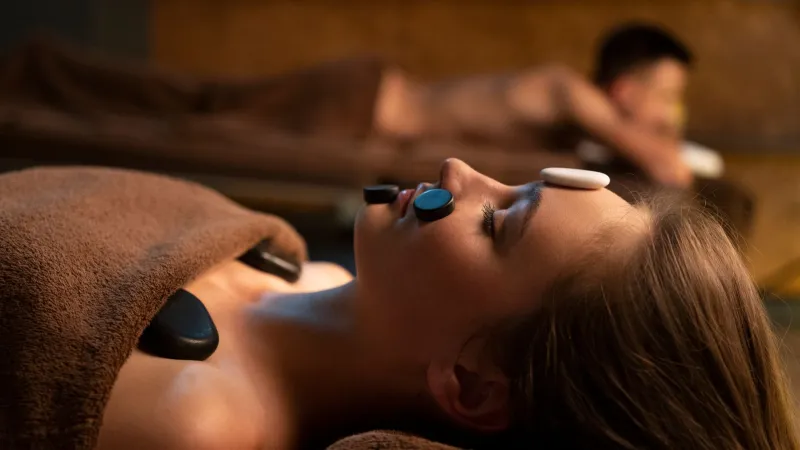
The mechanism makes physiological sense. The far-infrared heat generated by stones like black silica, bian stone, and tourmaline penetrates several centimeters below the skin's surface, gradually elevating core body temperature and triggering a parasympathetic nervous system response. Heart rate slows. Cortisol drops. The brain, no longer running its constant threat-assessment loop, gets quiet.
The mental chatter doesn't stop because you commanded it to. It stops because your body finally gave your brain permission to rest.
That's a fundamentally different entry point than any app-guided breathing exercise — and for many Americans, it's the first time they've experienced that kind of quiet from the inside out.
What Regular Visitors Actually Report
Talk to Americans who've made ganbanyoku a centerpiece of their Japan travel — not just a one-off curiosity — and a consistent set of behavioral shifts comes up.
The first is what one repeat visitor from Austin described as "decision fatigue disappearing." After a week of daily sessions, she noticed she was making choices faster and with less second-guessing. Not because she cared less, but because she'd stopped treating every decision like a performance review.
The second shift is a recalibrated relationship with boredom. Americans are notoriously allergic to it. But the ganbanyoku room, by design, offers nothing to consume. No content, no stimulation, no progress bar. You simply exist in it. And visitors who push through the initial discomfort of that emptiness often report that boredom transforms into something closer to spaciousness — a feeling they'd forgotten was possible.
The third shift is subtler but arguably the most durable: a changed relationship with efficiency itself. Not the abandonment of it, but a quieter, more confident version of it. The kind that knows when to push and — crucially — when to stop.
Strategic Rest as a Competitive Advantage
Here's the thing that makes the ganbanyoku paradox worth taking seriously beyond the philosophical: the outcomes are measurable.
Sleep quality improves. Focus sharpens. Inflammatory markers decrease with regular thermal therapy. The body recovers faster from physical stress. These aren't soft wellness claims — they're documented physiological responses to the kind of deep, sustained heat exposure that ganbanyoku delivers.
But the psychological outcomes may be the more significant story for American travelers. In a culture that has monetized every waking moment, discovering that strategic non-doing produces tangible results is genuinely disorienting. And disorientation, it turns out, is often where the real learning lives.
The spreadsheet traveler who wandered into the rock bath on day three? They usually end up building the next trip around it.
Not because ganbanyoku fixed them. But because an hour on warm stone gave them enough ma to finally hear what they'd been too busy to notice.
And that, as it turns out, is worth more than any temple on the itinerary.